
Harar sits in the eastern highlands of Ethiopia, 500 kilometres from Addis Ababa, enclosed within a medieval wall that has stood for five centuries. Inside it: 82 mosques, a network of alleyways so narrow that two people can barely pass, and a culture distinct from anywhere else in the country.
Every night, after dark, wild spotted hyenas come to the edge of the city to be fed.
Harar is one of the more surprising places Ethiopia produces — a UNESCO World Heritage Site, one of the holiest cities in Islam, and the setting for a tradition with no real equivalent anywhere in the world.
Harar Jugol: The Walled City
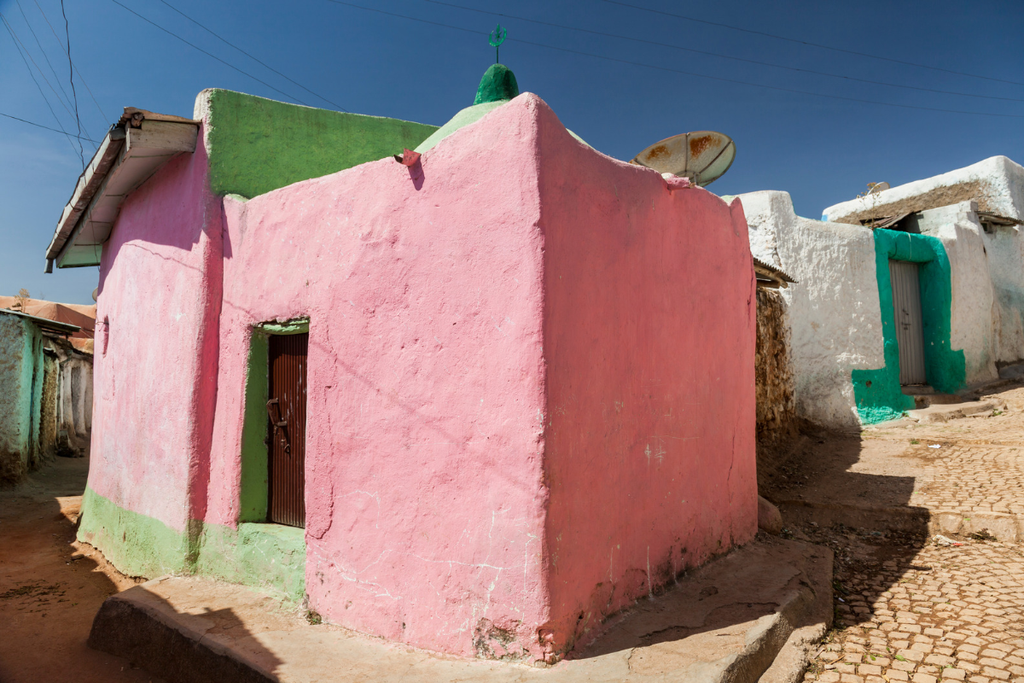
The old city of Harar — known as Jugol — is enclosed by a wall built in the 16th century, stretching roughly 3.5 kilometres around its perimeter. Five gates punctuate the wall, each historically associated with a different ethnic group that used it as its principal entrance. The wall and old city were inscribed as a UNESCO World Heritage Site in 2006.
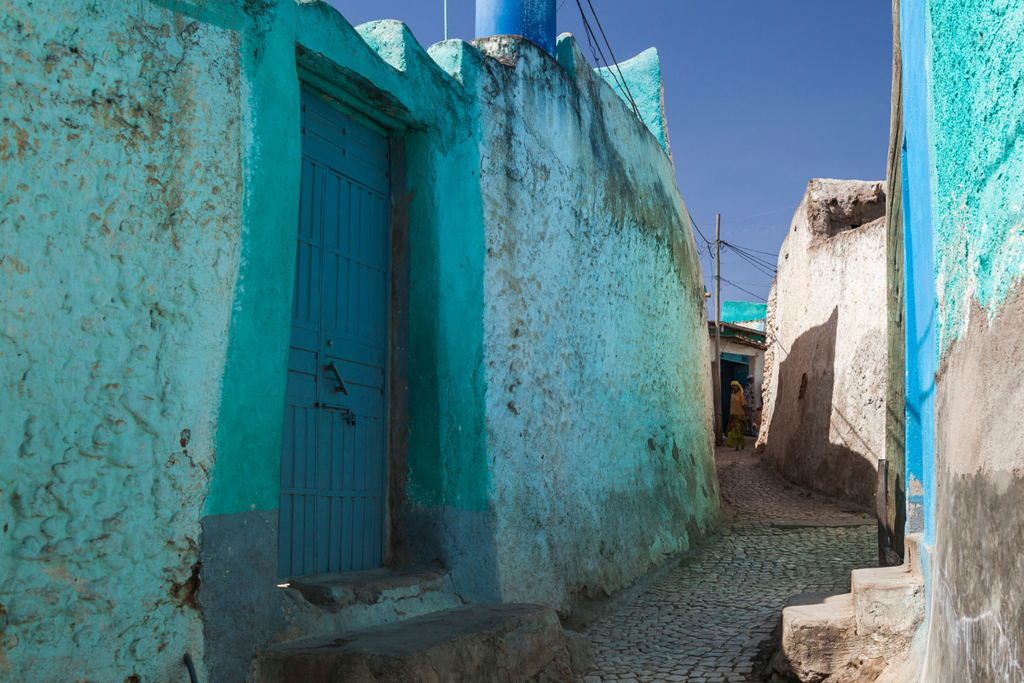
Inside, the streets narrow to the width of a donkey path. The layout is organic, accumulated across centuries, with no grid and no obvious logic to a first-time visitor. You will get lost. This is not a problem — the old city is small enough to navigate by landmark once you have your bearings, and the disorientation of the first hour is part of what makes it interesting.
Harar has its own language — Harari, spoken by the Adere people — and its own architectural tradition. The facades of Harari houses are plain and give little away from the outside; the interiors open into elaborate multi-level rooms with walls entirely covered in shelves displaying baskets, ceramics, and religious objects. This tradition of interior decoration is unique to Harar and unlike anything in the rest of Ethiopia.
The city’s markets — particularly the central Shoa Gate market area — are busy and mixed: Harari, Oromo, Somali, Amhara traders, all operating in the same narrow space. Coffee, spices, khat (a mildly stimulant leaf chewed across the Horn of Africa), cloth, and household goods.
Islam in Harar
Harar is considered one of the holiest cities in Islam — some traditions hold it the fourth holiest, after Mecca, Medina, and Jerusalem. Whether or not that ranking is universally accepted, the city’s religious significance is not in doubt: it was a major centre of Islamic scholarship and trade from the 16th century onward, and its 82 mosques — the highest density of any city in the world relative to its area — give some sense of how thoroughly religious life permeates it.
The Grand Mosque (Jami Mosque), built in the 16th century, is the oldest and most significant. Non-Muslims may not enter the mosques, but the religious atmosphere of the city is visible everywhere: in the call to prayer that layers across the old city five times a day, in the Islamic calligraphy on doorways, in the rhythm of daily life around the mosques.
The relationship between Harar’s Islamic identity and Ethiopia’s majority Orthodox Christian culture has been managed through coexistence for centuries. The old city is Muslim; the newer parts of Harar that surround Jugol are more mixed. The transition between the two — stepping through one of the old gates — is one of the more immediate cultural shifts available in Ethiopian travel.
The Hyena Feeding
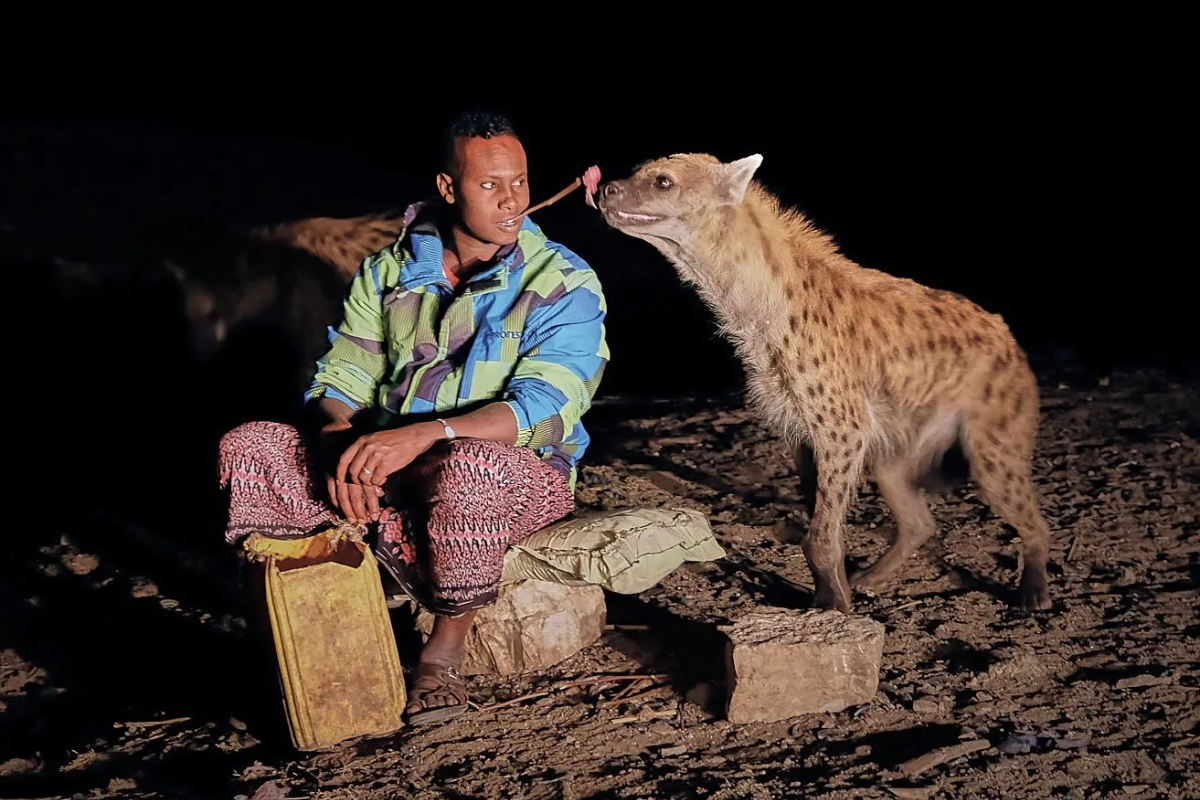
Every night, wild spotted hyenas come to two locations on the outskirts of Harar’s old city to be fed.
The tradition is centuries old, though its exact origin is disputed. One account holds that it began during a famine, when hyenas were fed to prevent them from attacking livestock and people. Another traces it to a Sufi saint who established a relationship with the hyenas as a spiritual act. What is clear is that specific families — the Hyena Men of Harar — have maintained the practice across generations, and that the hyenas have learned to associate these locations with food.
The feeding takes place after dark, at two sites: one near Erer Gate, one near Fallana Gate. The Hyena Man arrives with a basket of meat scraps and offal. He calls to the hyenas — specific calls, specific animals who know him by name. The hyenas emerge from the darkness: large, spotted, yellow-eyed, more impressive in person than any photograph prepares you for.
The feeding itself is direct: the Hyena Man holds a piece of meat in his hand, or between his teeth, and the hyena takes it. Visitors can participate — holding a short stick with meat attached, offering it as the hyenas approach. The hyenas take the food and retreat a few steps before returning.
There is nothing theatrical about this. The Hyena Man is not performing — he is doing what his family has done for generations, and the hyenas are responding to a learned relationship that goes back longer than anyone present can account for. The strangeness of the experience comes from its matter-of-factness: wild animals, in the dark, at close range, treated as a routine.
A fee is paid to the Hyena Man; this is expected and appropriate.
Arthur Rimbaud in Harar
The French poet Arthur Rimbaud — who abandoned poetry at nineteen and spent the rest of his life in Africa — lived and worked in Harar for much of the 1880s, trading coffee, skins, and eventually arms. He lived in Harar longer than anywhere else in his adult life.
The house associated with him — known as Rimbaud’s House, though his actual residence is disputed — now operates as a small museum containing photographs, documents, and a collection of materials relating to his years in Ethiopia. For visitors with any interest in literature, it is worth an hour. For those without, it remains a curiosity: that one of the 19th century’s most significant poets ended up in this particular walled city in the Ethiopian highlands and found it worth staying.
Getting to Harar
The nearest airport is Dire Dawa, 55 kilometres west of Harar, served by Ethiopian Airlines from Addis Ababa. The drive from Dire Dawa to Harar takes approximately one hour on a good road. Harar itself has a small airport with limited service; Dire Dawa is the more reliable entry point.
Overland from Addis Ababa, the journey is approximately eight to nine hours by road — possible but long. Most visitors fly.
Where to stay: Accommodation options in Harar range from small guesthouses within the old city walls to more comfortable hotels in the newer town surrounding Jugol. Staying inside the walls is the more atmospheric option and puts you close to the old city at night.
How long to spend: Two nights is the minimum to do Harar justice — one full day in the old city and markets, one evening for the hyena feeding with time to explore further. Three nights is more comfortable.
When to visit: Harar is worth visiting year-round. The hyena feeding happens nightly regardless of season. The old city is most atmospheric in the cooler months (October to February).
Visiting Harar with Absolute Ethiopia
Harar is one of the more distinctive stops we include on eastern Ethiopia itineraries, often combined with the Danakil Depression or a Dire Dawa overnight. It adds a dimension to an Ethiopia trip that the northern historic circuit doesn’t offer — a different religion, a different architecture, a different relationship between people and the natural world.
[Get in touch via WhatsApp to discuss eastern Ethiopia itineraries →]