
Ethiopia has more rock-hewn churches than any other country on earth. Carved directly from volcanic rock — no external building materials, no structural additions — they stand as some of the most extraordinary architectural achievements in human history. Many are still active places of worship. Priests live beside them, pilgrims walk hours to reach them, and liturgies have been performed inside them without interruption for centuries.
There are two main regions to visit. Lalibela, in the Amhara highlands, is the most famous — a UNESCO World Heritage Site containing eleven churches carved from a single rock plateau, built close together and connected by tunnels and ceremonial walkways. Tigray, in the north, is the other: a scattering of churches built into cliff faces across a remote mountain landscape, some requiring ropes and climbing to reach, others accessible by foot.
They are different experiences. Lalibela is a pilgrimage site, dense with history and ceremony, best visited over two days with a local guide who knows each church and its significance. The Tigray churches are physically demanding, spread across a wide area, and reward visitors who want to move slowly through a landscape rather than work through a checklist.
This guide covers both.
Lalibela: The Eleven Rock-Hewn Churches
The churches of Lalibela were carved in the 12th and 13th centuries under King Gebre Mesqel Lalibela, who according to tradition intended to create a new Jerusalem in Africa after Muslim forces cut off the pilgrimage routes to the Holy Land. The result is a complex of eleven churches, each carved from the same volcanic rock plateau, organised into three groups connected by trenches and tunnels.
They are still active. The Ethiopian Orthodox Church has held services here continuously since they were built. During major festivals — particularly Genna (Ethiopian Christmas, January 7) and Timkat (Epiphany, January 19) — tens of thousands of pilgrims fill the site.
A full visit takes two days. A rushed single day leaves most churches unseen.
Northern Group
Bete Medhane Alem (House of the Saviour of the World) is the largest rock-hewn church in the world — 33 metres long, 23 metres wide, and 11 metres high, supported by 72 external and 36 internal columns. It is the first church most visitors enter and the one that establishes the scale of what Lalibela represents. The interior contains three altars and the Ark of Lalibela, a replica of the Ark of the Covenant.
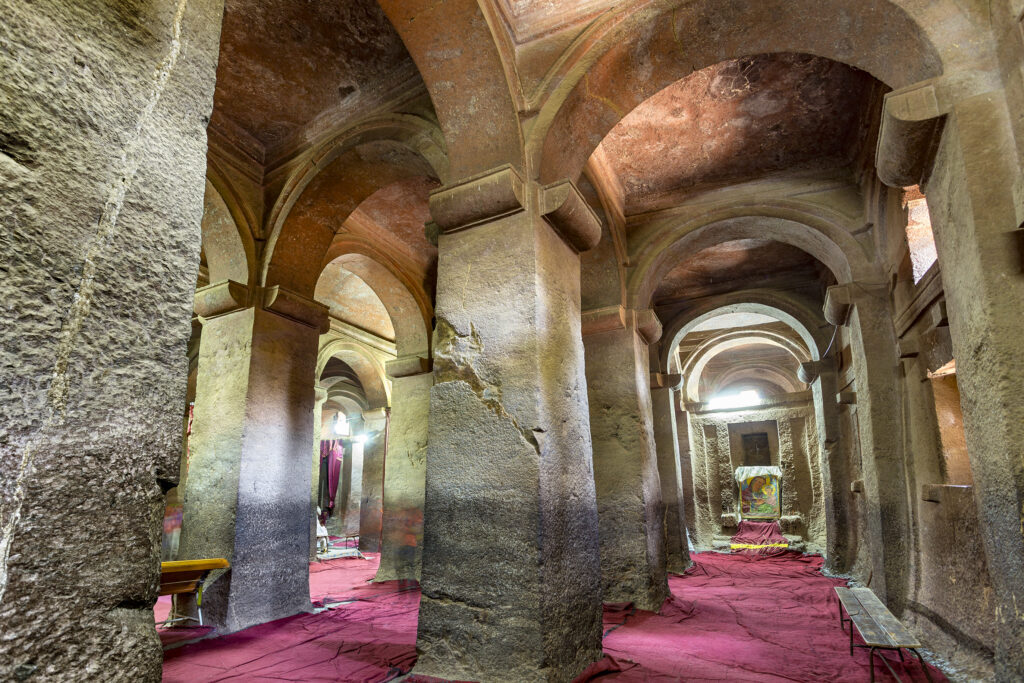
Bete Maryam (House of Mary) is the oldest church in the complex and considered the most sacred. Its interior walls are covered in paintings — geometric patterns, crosses, birds, figures from biblical narrative — that have accumulated over centuries. The courtyard outside is where pilgrims gather for major festivals.
Bete Maskel (House of the Cross) and Bete Denagel (House of Virgins) are smaller chapels opening off Bete Maryam’s courtyard. Bete Denagel is said to commemorate Ethiopian nuns martyred in the sixth century.
Bete Golgotha Mikael (House of Golgotha) holds the tomb of King Lalibela himself. The interior contains a series of life-size relief figures carved into the walls — some of the finest examples of medieval Ethiopian sculpture in existence. The inner sanctuary is open to men only.
Eastern Group
Bete Amanuel (House of Emmanuel) is widely considered the most finely crafted church in Lalibela. Its exterior walls are carved in precise horizontal registers of projecting and recessed stone, imitating the timber-framed construction of the Aksumite buildings that preceded it. The interior is just as careful — the proportions, the columns, the carved crosses in the ceiling.
Bete Abba Libanos (House of Abbot Libanos) is semi-monolithic: carved on three sides from the cliff face but sharing a wall with the rock behind it. Legend attributes it to Queen Maskal Kibra, wife of King Lalibela, who carved it in a single night with the help of angels.
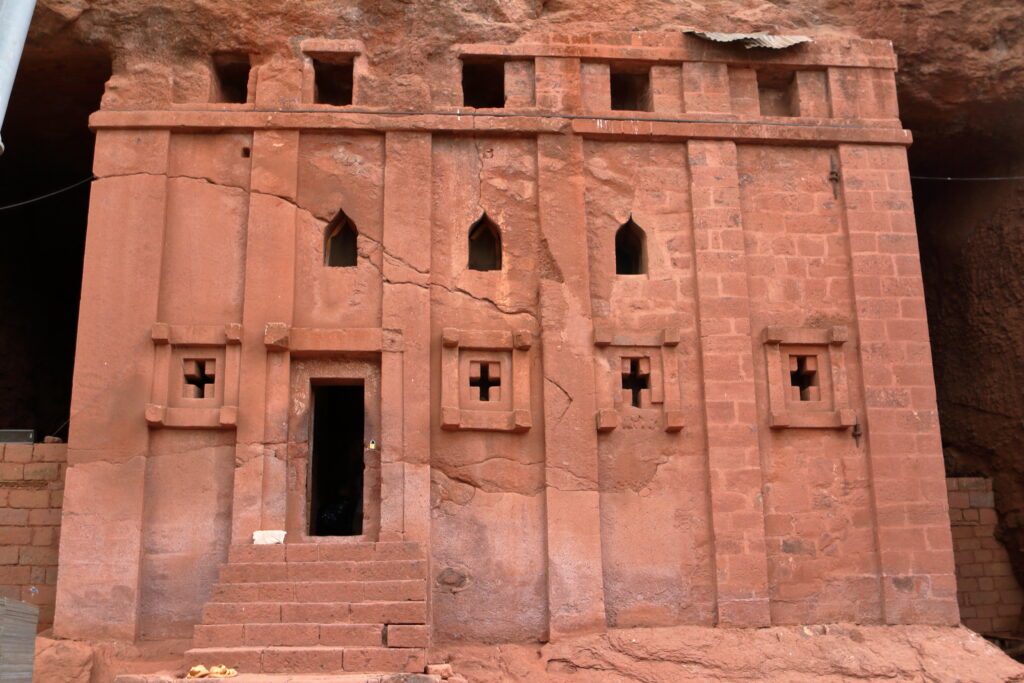
Bete Gabriel-Rufael (House of Gabriel and Raphael) sits at the edge of a deep trench and is reached by a bridge. It may have originally functioned as a royal palace before being converted to a church. Its walls show evidence of an older structure underneath the Christian carvings.
Bete Qeddus Mercoreos (House of St. Mercurios) is partially collapsed but retains wall paintings and an important collection of medieval crosses and manuscripts.
The Iconic Standout
Bete Giyorgis (House of St. George) stands alone, separated from the other groups, and is the image most associated with Lalibela. Carved as a perfect cube descending into a deep pit in the rock, its roof is decorated with three nested Greek crosses in precise relief. It was reportedly the last church built by King Lalibela, constructed as an act of penance to St. George after the saint complained of being left out. There is nothing else quite like it.
Near Lalibela: Yemrehana Krestos
Located about 42 kilometres from Lalibela, Yemrehana Krestos is a pre-Lalibela church built inside one of the largest northeast-facing caves in Ethiopia. It predates the Lalibela complex by around a century and uses Aksumite construction techniques — alternating layers of wood and stone — that influenced the later rock-hewn work.
The journey to reach it involves a walk through farmland and forested hillside. The cave’s interior holds the church and, behind it, the mummified remains of thousands of pilgrims who came here to die close to the site. It is quieter than Lalibela, less visited, and in many ways more affecting.
It is easily added as a half-day from Lalibela.
The Tigray Churches
The Tigray region contains over 120 rock-hewn churches, most of them carved into cliff faces between the fourth and fourteenth centuries. A handful are easily accessible. Others require climbing with ropes, walking along narrow ledges above significant drops, or navigating unmarked mountain paths. All require a local guide — both for access and for safety.
They are not comparable to Lalibela in terms of scale or concentration, but several are extraordinary in their own right.
Abuna Yemata Guh is built into a sheer cliff face at around 2,580 metres, accessible by a climb and a walk along a narrow rock ledge above a drop of several hundred metres. The interior is small — a single nave — but its ceiling and walls are covered in sixth-century frescoes in exceptional condition. The atmosphere at altitude, reached on foot, makes it unlike any other church visit.
Maryam Korkor is semi-monolithic, carved into the cliff face in the Geralta mountains. The exterior is plain; the interior is large, with cruciform pillars and arches covered in 17th-century frescoes, including a well-known depiction of Jesus in utero. The approach offers views across the Geralta plateau.
Daniel Korkor is a small two-room church close to Maryam Korkor on the same mountain, decorated with paintings applied in natural berry pigments that have survived intact.
Abune Gebremchael is carved seven metres into a sheer cliff face in the Geralta mountains. Most visitors use ropes to reach the entrance.
Keshia Medihanialem (Holy Saviour) in the Geralta shows strong Byzantine influence in its interior painting. It is one of the more accessible Tigray churches and is notable for its entrance mechanism — a wooden stick balanced through a hole in the door to push open the interior lock.
The Church of Abreha and Atsbeha is one of the oldest and largest churches in Tigray, said to have been built by the twin kings who first brought Christianity to Ethiopia in the fourth century. It holds a significant collection of treasures — crosses, manuscripts, ceremonial objects — accumulated over seventeen centuries.
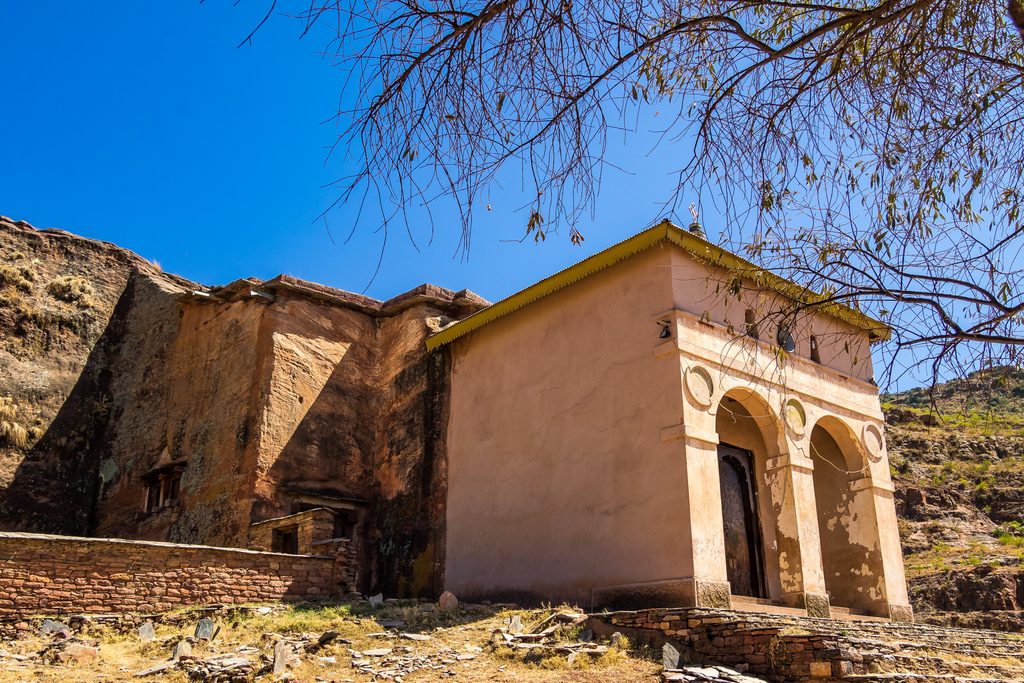
Cherkos Wukro is the most accessible of the Tigray churches, located close to the town of Wukro and requiring no climbing to enter. Its ceiling shows damage from a raid by Ahmad ibn Ibrahim al-Ghazi in the sixteenth century. Despite this, the church is intact and still active.
Debra Damo is a sixth-century monastery on top of a flat-topped mountain, accessible only by climbing a rope up a sheer cliff face. It houses some of the earliest surviving Christian manuscripts in existence and the oldest original church building in Ethiopia. Women are not permitted to visit.
Practical Information
When to visit October to January is the best period — dry roads, comfortable temperatures, and the most significant festivals. Genna (January 7) and Timkat (January 19) both centre on Lalibela and draw large crowds of pilgrims. If you want to experience the site during a festival, book well in advance. March to May is the wet season and the Tigray roads become difficult.
Getting to Lalibela Ethiopian Airlines flies daily from Addis Ababa to Lalibela. The flight is approximately one hour. Lalibela can also be reached by road from Addis Ababa — around 12 hours — or combined with the northern historic circuit by road from Aksum or Gondar.
Getting to the Tigray churches The Tigray churches are spread across a wide area centred on Mekelle, which has a domestic airport. Reaching individual churches requires a 4WD and a local guide. Geralta — the area with the highest concentration of accessible churches — is about 60 kilometres south of Mekelle.
What to wear Shoes must be removed before entering any church — bring socks for the rock floors, which are cold in the mornings. Women should cover their hair inside the churches. Both men and women should cover their shoulders and knees.
Guides A local guide is essential at Lalibela to navigate the site, explain the history of each church, and manage access to the inner sanctuaries. At the Tigray churches, a local guide is required both for navigation and for safety on the approaches.
Visiting with Absolute Ethiopia
The rock-hewn churches of Lalibela and Tigray are central to most of our northern Ethiopia itineraries. We build in the time to see them properly — Lalibela over two days, the Tigray churches as a dedicated extension or combined with Aksum and Gondar on the full northern circuit.
[Get in touch via WhatsApp to discuss itineraries →] [Explore our northern Ethiopia tours →]