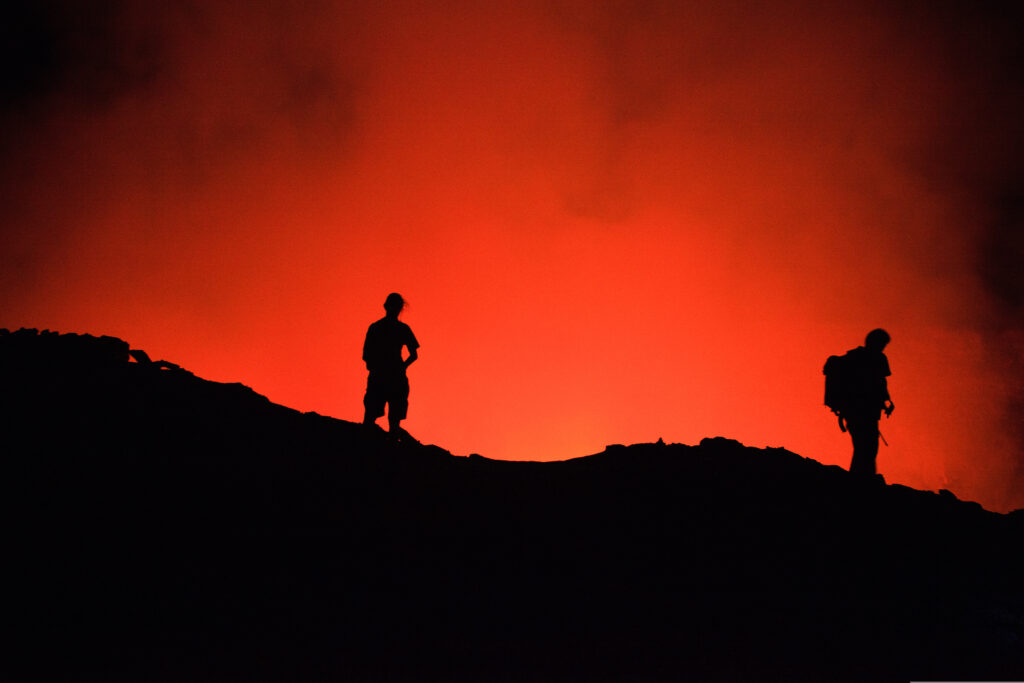
The Danakil Depression is one of the most extreme landscapes on Earth — active lava lake, sulphur fields, salt flats and camel caravans. Here’s what visiting actually looks like.
The Danakil Depression sits in the Afar region of northeastern Ethiopia, roughly 120 metres below sea level at its lowest point. It is one of the hottest, driest, and most geologically active places on the planet — and one of the most compelling reasons to visit Ethiopia if you are the kind of traveller who wants something genuinely unlike anything else.
The landscape here is not subtle. Active lava lakes, sulphur-encrusted volcanic craters in yellow and green, salt flats that stretch to the horizon, and camel caravans moving salt blocks by hand exactly as they have for centuries. It is the kind of place that needs no embellishment.
Here is what the Danakil actually contains, how it compares to similar destinations worldwide, and what visiting looks like in practice.
How It Compares to Other Extreme Destinations
There are other geothermal and volcanic destinations around the world — Yellowstone in the USA, Rotorua in New Zealand, Iceland’s lava fields, Kilauea in Hawaii. None of them are quite like this.
Yellowstone and Rotorua have similar geology — hot springs, sulphur fields, vivid mineral colours — but they are managed, accessible, and surrounded by infrastructure. You drive to a car park and walk a boardwalk. The Danakil has no boardwalks. Dallol’s acid pools sit unmarked on a crust that can be thin in places, and surface temperatures in summer regularly exceed 50°C. Scientists studying Dallol have recorded conditions so extreme — near-zero pH, temperatures over 100°C at the surface — that researchers have debated whether any life can survive in its pools at all.
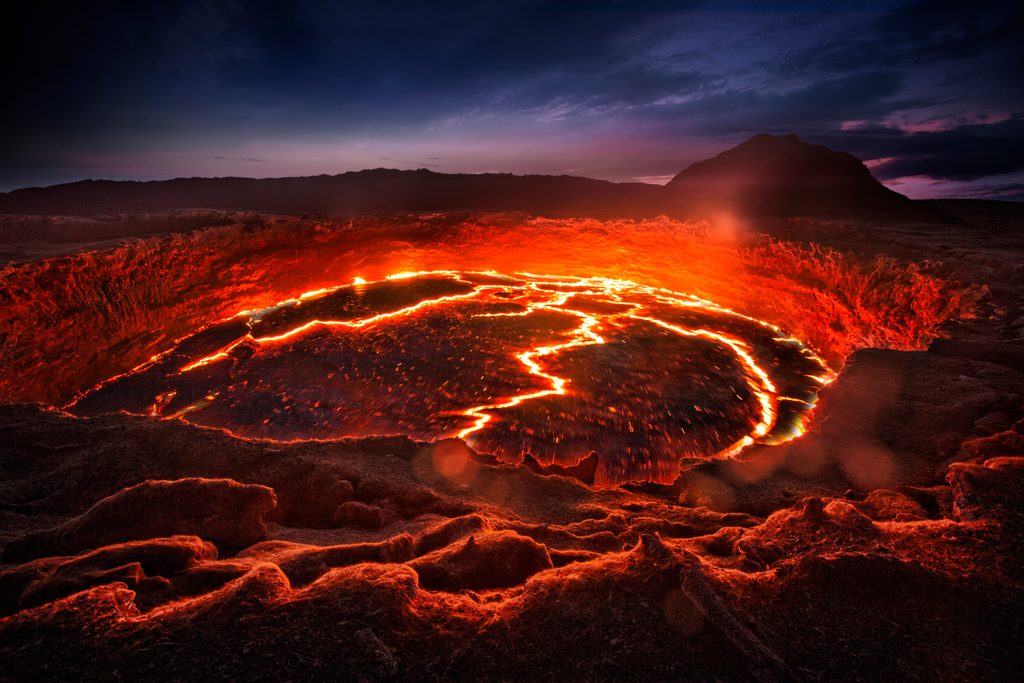
Kilauea in Hawaii is the closest comparison for Erta Ale specifically, since both have lava lakes. But Hawaii has visitor centres, paved roads, and ranger stations. Erta Ale requires a multi-hour night trek across hardened lava, reached after a full day’s drive by 4WD convoy from the nearest city.
The other volcanoes on Earth with permanent lava lakes are Nyiragongo in the Democratic Republic of Congo and Mount Erebus in Antarctica. Nyiragongo has significant ongoing security concerns. Antarctica is self-explanatory. That makes Erta Ale, for most travellers, the most reachable permanent lava lake on Earth — which is the clearest single answer to why people travel so far to get here.
What also sets the Danakil apart from purely geological destinations is the human layer. The Afar salt trade has operated here for centuries and continues today. The people working the salt flats are not a tourist attraction — they are running a functioning economy in one of the harshest environments on Earth. That context gives the experience a depth that a purely geological site does not have.
One thing worth knowing before you go: the Danakil is an actively changing region. In November 2025, Hayli Gubbi — a volcano in the same depression — erupted for the first time in recorded history. Erta Ale’s lava lake visibility has also varied since activity in 2017 altered the crater geometry. Conditions at any given site may differ from what you have seen in photographs. We keep current with access and conditions through our guides on the ground and will give you an honest picture when planning your trip.
Who This Trip Is For
The Danakil attracts a specific kind of traveller. You do not need to be an experienced trekker or geologist, but you do need to be comfortable with physical discomfort, basic accommodation, and a genuinely remote environment.
It tends to suit people who have already covered more conventional destinations and want something they cannot find anywhere else. Photographers, geology enthusiasts, and travellers drawn to extreme environments for their own sake make up a large share of visitors. It also works well as one leg of a broader Ethiopia itinerary — most visitors combine it with the northern historic circuit or Lalibela rather than visiting the Danakil alone.
Who Should Not Go
This is not a trip for everyone, and it is worth being direct about that.
Children should not visit the Danakil. The combination of extreme heat, a multi-hour night trek on uneven terrain, sulphur gas at the crater, no medical facilities within reach, and basic camping conditions makes it genuinely unsuitable for under-18s.
People with respiratory conditions — asthma, COPD, or any sensitivity to air quality — should discuss this trip with a doctor before committing. The sulphur emissions at Erta Ale’s crater are significant and unavoidable.
People with heart conditions should also seek medical advice first. The combination of heat and exertion during the Erta Ale trek places real demands on the cardiovascular system even in the cooler months.
Anyone planning to visit between April and September should wait. Temperatures during these months are dangerous regardless of fitness. The October to March window is a safety requirement, not simply a preference.
Anyone who needs comfortable accommodation will be disappointed. This is camping on volcanic rock and basic lodges in remote villages. For the right traveller, that is part of the experience. For anyone who needs comfort to enjoy a trip, this is not the right destination.
Erta Ale
Erta Ale is a shield volcano rising from the floor of the depression, and it holds one of the few permanent lava lakes on Earth. At night, the crater glows — the molten rock shifting and surfacing in a display that is difficult to describe if you have not seen it.
Tours reach Erta Ale by 4WD from Mekele, a short domestic flight from Addis Ababa. From the village of Kuswaad, where Afar guides join the group, the trek to the crater rim takes roughly three to four hours on foot. Arriving at dusk and camping near the rim to watch the lava lake after dark is the standard approach — and the right one.
The hike is not technically demanding but should not be underestimated. The heat at lower elevation is significant even in the cooler months, and the crater emits sulphur gas. Covering your nose and mouth near the rim is standard practice.
Note on current conditions: Lava lake visibility at Erta Ale has varied since 2017 and continues to change. When you book, we will give you an up-to-date picture based on current reports from our guides on the ground.
Dallol
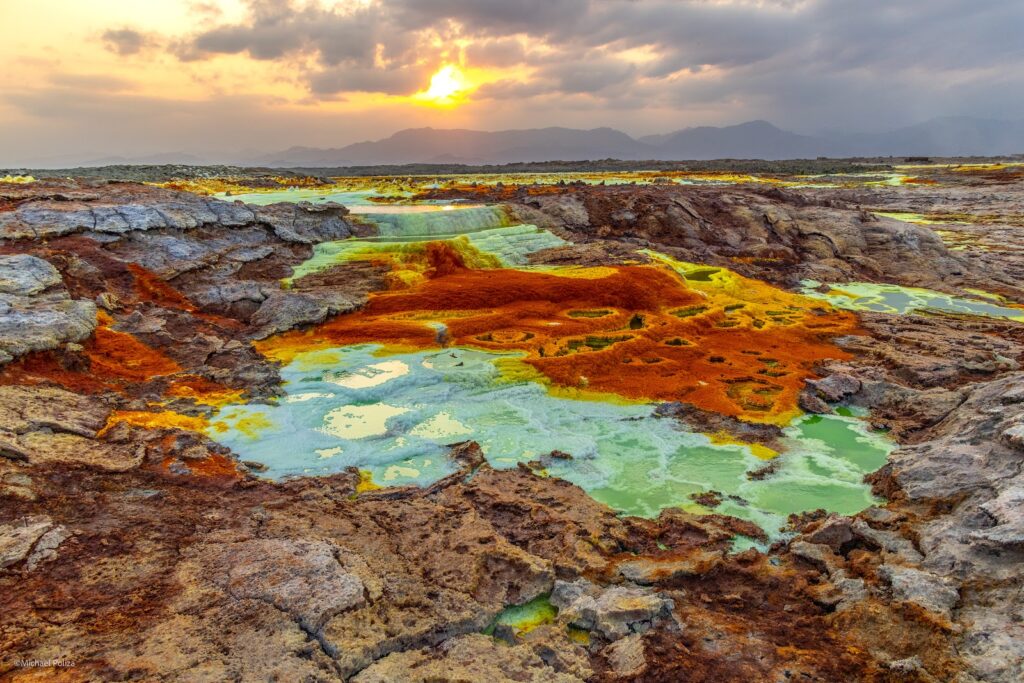
Dallol is the most visually striking part of the Danakil — a hydrothermal field at the top of a cinder cone volcano where acidic hot springs have deposited layers of sulphur, iron, and salt over thousands of years.
The result is a landscape of yellows, greens, oranges, and reds that has no equivalent anywhere else in Ethiopia and very few equivalents anywhere on Earth. Pools of acid sit alongside salt formations shaped into columns and ridges. The whole area is in constant low-level change — new formations appear and older ones dissolve as the hydrothermal activity continues underground.
This is not a place to walk freely — staying on marked paths with a guide is essential, as the crust in some areas is thin over boiling water below.
Ahmed Ela and the Salt Flats
At Ahmed Ela and the surrounding salt flats, the floor of the Danakil Depression is covered in a thick layer of salt left behind as ancient inland seas evaporated over millennia. The Afar people who live in this area have mined salt here for generations, cutting blocks by hand and loading them onto camels for the long walk to market towns.
Watching a camel caravan depart at dawn — dozens of camels loaded with salt blocks moving in a line across the white expanse — is one of those rare travel experiences that stays with you. The salt trade here is genuinely ancient and continues today.
Lake Afrera
Lake Afrera (also known as Lake Giulietti) sits at roughly 100 metres below sea level within the depression. It is a hypersaline lake with a salt content high enough to float in comfortably. The single island in the lake, Franchetti Island, sits at one of the lowest elevations of any island on Earth.
The lake is most commonly visited as part of a longer Danakil circuit, though it is a quieter stop compared to Dallol and Erta Ale.
Practical: When to Go
The Danakil is only visited between October and March. Outside these months, daytime temperatures at ground level regularly exceed 45°C and conditions become unsafe for travellers. Even within the October–March window, early morning starts are standard practice — most key sites are reached before the heat peaks.
If you are planning a Danakil visit as part of a broader Ethiopia itinerary, November and early December are the most comfortable months.
Practical: How It Works
All Danakil tours start in Mekele, which is reached by a short domestic flight from Addis Ababa. From Mekele, the journey into the depression is by 4WD convoy — the roads are rough and the distances significant.
Tours typically run three to five days depending on which sites are included. Accommodation in the depression itself is basic — camping at designated sites near Erta Ale and simple lodges at Ahmed Ela. This is not a comfortable trip by conventional standards. It is a genuine expedition into one of the world’s most remote environments.
All tours into the Danakil include armed Afar scout escorts, which are a requirement in the region. This is standard practice and not a cause for concern — it is simply how travel here works.
Absolute Ethiopia’s Danakil Tours
We run two Danakil itineraries depending on your time and whether you want the depression as a standalone trip or combined with the northern historic circuit.
- 3-Day Danakil Depression Tour: Erta Ale & Dallol — starts and ends in Mekele, focused entirely on the depression
- 12-Day Awash National Park, Danakil Depression & Lalibela — starts in Addis Ababa, combines the Danakil with Awash wildlife and Lalibela’s rock-hewn churches
Both are private tours — your group, your pace, no shared vehicles with other bookings.
Get in touch via WhatsApp to discuss dates and availability